Makita: Over a Century of Precision Engineering
Founded in 1915 in Nagoya, Japan as an electric motor repair and sales company, Makita has spent over a century building tools defined by precision engineering and reliability. The company introduced the world’s first battery-powered drill in 1978 — a development that changed the construction industry permanently — and has remained at the forefront of cordless tool development through five decades of continuous innovation. Today, Makita’s 18V LXT platform covers over 280 tools, making it the broadest single-voltage cordless ecosystem available from any manufacturer.
Makita’s engineering philosophy differs meaningfully from American competitors. Where Milwaukee emphasizes maximum performance and electronic sophistication, and DeWALT emphasizes platform breadth and battery innovation, Makita emphasizes precision manufacturing, clutch engineering, and reliability through refinement rather than specification escalation. The result is tools that feel extraordinarily well-made in the hand — smooth clutch action, quality bearings, excellent fit and finish — and earn a reputation for lasting longer in real-world professional use than many higher-spec alternatives.
The 18V LXT Platform: The World’s Largest 18V System
The 18V LXT (Lithium-Ion eXtreme Technology) platform is Makita’s flagship ecosystem and the world’s largest 18V cordless tool system. Introduced in 2005, LXT has been evolving continuously for nearly two decades — a maturity that shows in the depth and coherence of the tool lineup. Over 280 tools share the LXT battery format, covering not just the obvious categories (drills, saws, grinders) but highly specialized tools that other platforms don’t address: dedicated tile saws, pipe inspection cameras, metal shears, inflators, radios, heated garments, and outdoor power equipment from string trimmers to chainsaws.
The practical implication of 280+ LXT tools is significant for multi-trade professionals and shops. A woodworker who also does finish carpentry, occasional concrete work, and property maintenance can run their entire tool inventory on LXT batteries. A general contractor whose crew spans framing, electrical rough-in, finish carpentry, and site cleanup can standardize every cordless tool on one battery platform. No competitor matches this ecosystem breadth at a single voltage.
Star Protection Computer Controls: Makita’s electronics system managing real-time communication between battery and tool. Monitors temperature, voltage, current, and RPM to optimize performance and prevent damage from overdischarge, overheating, and overloading. The system also enables diagnostic data that helps identify tool and battery health over time.
Battery options: 2Ah compact, 3Ah standard, 4Ah professional, 5Ah extended, 6Ah high-capacity. The 4–5Ah range represents the professional sweet spot. Makita also offers Rapid Optimum Chargers that charge a 5Ah battery in approximately 45 minutes with active temperature monitoring during charging.
The 40V max XGT Platform: High-Power Applications
The XGT (eXtreme Grinding Technology) platform delivers significantly higher performance than 18V LXT in the most demanding tool categories. Introduced to address applications where LXT reaches its practical limits — 7.25-inch circular saw at full speed through hardwood, large-diameter angle grinder work, heavy-duty rotary hammer drilling — XGT uses a dedicated 40V battery format that is not compatible with LXT batteries.
The performance advantage of XGT over LXT is real and measurable. The GSH01Z 40V XGT circular saw delivers meaningfully faster cut completion through hardwood than the LXT equivalent. The GWS01Z 40V XGT grinder sustains higher RPM under load. For professionals who need maximum cordless performance in specific high-demand tools, XGT delivers it.
The trade-off is battery ecosystem separation. XGT batteries don’t power LXT tools. Adding XGT to a primarily LXT setup means managing and charging two different battery formats. For most professionals, the right approach is: use LXT for the vast majority of tools, add XGT specifically for the one or two applications where LXT’s performance ceiling is genuinely reached. Standard XGT batteries: 2.5Ah and 4Ah.
The 12V max CXT Platform: Ultra-Compact Precision
The CXT (Compact eXtreme Technology) platform prioritizes size and weight above all other specifications. CXT tools are dramatically smaller and lighter than LXT equivalents — the FD07Z CXT drill at 2.3 lbs fits entirely in one hand. Performance is lower than LXT, but for applications where tool compactness is the binding constraint — working inside panel boxes, driving screws in finished cabinetry, detail work in tight furniture spaces — CXT excels.
With fewer than 50 tools, CXT has significantly less ecosystem depth than Milwaukee’s comparable M12 platform (100+ tools). For electricians and finish carpenters who need compact tools for specific applications, CXT covers the basics well. For tradespeople who need compact trade-specific tools (pipe cutters, specialty automotive tools, inspection cameras), Milwaukee M12 is a stronger choice.
Top Makita Tools by Category
Drill/Drivers: XFD14Z (18V LXT flagship, 16-position precision clutch, 530 in-lbs) | XPH14Z (LXT hammer drill) | XFD13Z (compact LXT brushless) | FD07Z (12V CXT compact)
Impact Drivers: XDT16Z (LXT brushless, 1,500 in-lbs, 4-speed Assist Mode) | XDT13Z (LXT compact) | XDT11Z (LXT mid-range)
Circular Saws: XSS02Z (LXT 6.5″, 5,200 RPM) | GSH01Z (XGT 40V 7.25″ flagship)
Miter Saws: XSL08Z (LXT dual-battery 10″) | LS1019L (12″ corded, exceptional cut quality via linear ball bearing slide)
Grinders: XAG20Z (LXT 4.5/5″, variable speed 2,500–8,500 RPM) | GWS01Z (XGT 40V 4.5″)
Sanders: XOB01Z (LXT 5″ random orbit) | XBO01Z (LXT 3″x18″ belt sander)
Routers: XTR01Z (LXT compact fixed base) | RT0701CX7 (compact corded combo)
Oscillating: XMT04Z (LXT, 6,000–20,000 OPM variable)
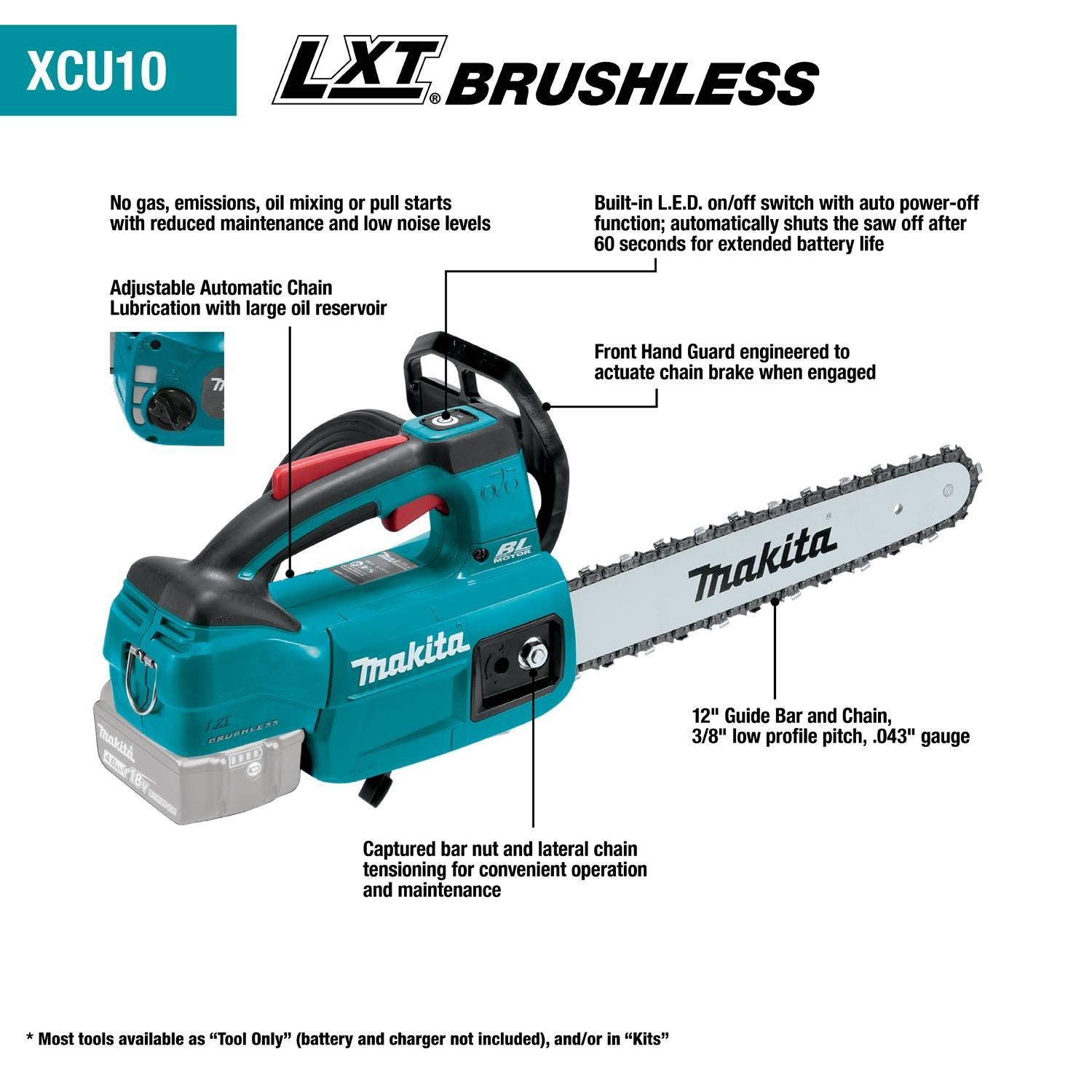
Outdoor Power: XCU04Z (LXT chainsaw, 14″ bar) | XRU15PT (LXT string trimmer) | XBU04PT (LXT blower)
Makita’s Precision Advantage: Why Woodworkers Choose Makita
Makita’s clutch engineering sets it apart from competitors in one critical application area: fine woodworking and cabinet installation. The XFD14Z’s 16-position clutch offers finer resolution in the low range than any competing professional drill. Positions 1 through 6 are genuinely distinct and useful for different wood densities and screw sizes — you can drive a pocket screw into maple at position 4 without either stripping the pocket or leaving the head proud. Many competitor drills have clutches where positions 1 through 5 are effectively indistinguishable, offering no useful fine control.
This precision matters in woodworking shops, cabinet making operations, and high-end finish carpentry where driving depth consistency defines product quality. It’s why Makita dominates these niches despite Milwaukee and DeWALT having higher peak torque numbers — peak torque is irrelevant when precise low-torque driving is what quality requires.
Makita vs Milwaukee vs DeWALT
Makita’s clear advantages: LXT ecosystem breadth (280 tools), precision clutch engineering, Japanese manufacturing quality and fit/finish, and variable-speed tools for applications requiring speed control (polishing, sensitive surface grinding). Makita’s relative disadvantages: M12 compact platform less developed than Milwaukee M12, no FLEXVOLT equivalent for high-voltage cordless (XGT requires separate battery investment), less electronic sophistication than Milwaukee FUEL tools.
Milwaukee leads in raw peak torque, M12 trade-specific tools, REDLINK PLUS protection, and ONE-KEY fleet management. DeWALT leads in FLEXVOLT high-voltage cordless and POWERSTACK battery compactness.
For woodworking shops, multi-trade operations valuing ecosystem breadth, and professionals who prioritize precision over peak power: Makita is the strongest long-term platform investment. Explore the complete Makita LXT, XGT, and CXT catalog at Pro Tools Hub.